
Domain Authority is the strength behind keywords
Domain authority is the real muscle behind your keywords—the ranking power that decides how high your website shows up in search results. A business owner once asked me, “I have all the right keywords, so why am I not ranking above my competitors?” The answer: it’s not just about having great keywords. Without domain authority, more muscles, those keywords don’t have the strength to push you past the competition.
It helps determine where you stand in comparison to other websites and shows potential customers whether they can trust yours as an authoritative source. A high score also indicates that visitors are finding value when they visit your site. Having a good domain authority score requires effort, dedication and a strategic approach to content marketing, but will pay off in regards to improving your brand’s visibility and reputation.

Quick Summary - 5 minute read
- What is Domain Authority
- A Review of The Main Components
- Google's View on Authority and Trust
- Step By Step Actions To Improve Your Domain Authority
What Exactly is Domain Authority
Domain Authority (DA) is a proprietary SEO metric developed by Moz that predicts how well your website will rank in search engine results. This domain-wide score ranges from 1 to 100—the higher the number, the greater your site’s potential to appear at the top of the page.
DA is calculated primarily by analyzing your site’s link profile. Your score is based on these 4 areas :
1) It All Starts With a Well Built Website
On-page SEO refers to the practice of optimizing individual web pages to improve their search engine rankings and attract relevant traffic. A crucial part of this process is ensuring your content is well-optimized for your target keywords. This involves integrating these keywords naturally into your headings (H2, H3, H4), introduction, and throughout the body of the text. Furthermore, crafting compelling meta titles and descriptions is vital, as they directly influence whether a user clicks on your link from the search results page. To enhance the user experience and keep readers engaged, your content must also be easy to read, utilizing formatting elements like bullet points and short paragraphs to improve clarity and structure.
2) Backlinking is Your Ability to Create Killer Content
The second way to increase your domain authority is by creating great content that’s link-worthy. Why should your content be amazing? Well, if people find your posts helpful, they’ll start to share it with others. This increases your chances of getting backlinks from high-authority websites, like education institutes or governmental bodies. And with links from different sites, you’ll also boost your root domains. All of which will contribute towards securing a high DA.
High-Impact Content Strategies
Original Research and Data
Conduct industry-specific surveys or analyze public data to uncover new trends. Journalists and bloggers frequently link to original statistics to support their claims.
The Skyscraper Technique
Find high-ranking content in your niche, create a significantly better version (more up-to-date, better design, or deeper detail), and then reach out to those who linked to the original to suggest your superior version
3) Linking Profile and Establishing Trust
Linking play a huge role in calculating domain authority. Not only that, but backlinks are one of the most important ranking factors. A study by Ahrefs showed that 55.24% of websites don’t get any organic traffic, since they don’t have any backlinks. Therefore, it’s safe to say that you need high-quality backlinks. But don’t forget to link internally and externally
This is the most critical area of DA. Moz evaluates the quantity and quality of links pointing to your site.
Linking Root Domains:
The number of unique websites (domains) linking to your site. One hundred links from one site are less valuable than one link from 100 different sites
Total Number of Links
The overall count of backlinks, including internal and external links.
Link Quality
he authority and relevance of the websites linking to you. Links from high-authority sites (like .gov or .edu domains) carry more weight.
4) Optimize the Website's Site Structure and Performance
Another factor in calculating domain authority is your site’s structure and its user-friendliness. With a proper structure, search engines can easily crawl your web pages and index them in search results.
Technical SEO focuses on optimizing your website’s infrastructure for search engine crawling and indexing, as well as user experience. Factors like site speed, mobile-friendliness, a logical site structure with clear internal linking, and a secure HTTPS connection all contribute to a positive user experience and signal to search engines that your site is high-quality and trustworthy.
Domain Authority is About Machine Learning and Comparisons
Moz DA is not an absolute score; it is a relative metric calculated through a machine learning algorithm.
Google SERP Comparison
The algorithm looks at how often a domain appears in Google’s real-world search results and adjusts its DA score to match that predictive behavior.
Logarithmic Scale:
The score is on a 1–100 logarithmic scale, meaning it is much harder to move from a score of 70 to 80 than it is to move from 10 to 20
You can check your current score using the Moz Domain Authority Checker
Google has it's own Authority based rating know as EEATS
In 2026, Google determines site authority through a complex set of signals rather than a single score. While third-party metrics like Domain Authority estimate these, Google’s internal systems prioritize E-E-A-T (Experience, Expertise, Authoritativeness, and Trustworthiness) and technical health.
Domain Authority is a Third-Party Proxy
Official metrics like "Domain Authority" (Moz) or "Domain Rating" (Ahrefs) are not used by Google's internal algorithms. Instead, Google uses its own complex systems to measure E-E-A-T (Experience, Expertise, Authoritativeness, and Trustworthiness).
Site-Wide Authority "Empowers" Keywords
Google confirms it uses site-wide signals that map to authority. When a domain is viewed as a high-quality resource, its new content and keywords often rank faster and higher because Google already "trusts" the source.
Trust and Authority are Interlinked
Improving your site’s perceived authority—primarily through high-quality backlinks and topical depth—signals to Google that your site is a reliable resource, giving your specific keywords the "weight" they need to compete in crowded search results.
Google and Moz Both Agree That Keywords Are Not The End All
Both Google and Moz agree that using the right keywords is not enough to secure the top spot in search results. You cannot expect to outrank your competitors based on content alone if they have significantly more authority than you do. Search engines look for trust and credibility, so even perfect keyword usage needs the backing of a strong domain. To truly compete for higher rankings, you must focus on building your site’s authority alongside your content strategy.
Domain Authority and EEAT (Expertise, Experience, Authoritativeness, and Trustworthiness) share a common goal: both measure the credibility and influence of your site in the eyes of search engines. While Domain Authority looks at the overall strength and reputation of your website, EEAT goes deeper into the quality of your content and the reliability of your authorship. Both are crucial for boosting your position in search results. While their methods differ, their message is the same: there is much more to a keyword than the keyword itself.
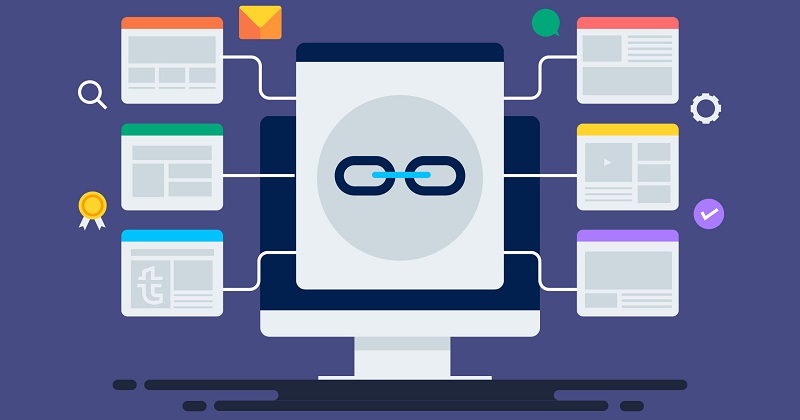
Back To The Business Owners Ranking Question
Do you recall that business owner who was baffled about why, despite having all the right keywords, he still couldn’t outrank his competitors? Let’s help him outrank his competitors, using the Domain Authority approach and following these steps:
Step 1 - What Makes For A Well Built Website
The question is – How should I implement localized content and keyword optimization
To rank for local searches, your website content must reflect local intent. Here is how you can optimize your content for your specific area:
Target conversational keywords
Focus on long-tail keywords that mimic how people speak, such as "best coffee shop near Central Park" or "emergency plumber in [City Name]."
Use location-based keywords:
Incorporate the city or neighborhood name naturally into headers, meta tags, and body content (e.g., "Thrift Store in Hiram Georgia").
Example
Here is an Example of a well built Website with localized content and keyword optimization
View PageStep 2 - How Do I Develop Content and Build Trust
Strategically encouraging customer reviews on reputable platforms can generate valuable backlinks, which, when combined with a strong internal and external linking structure on your own website, significantly boosts your domain authority. This comprehensive approach signals trustworthiness and relevance to search engines, ultimately improving your overall rankings.
Does getting more reviews really improve my search ranking?
Yes - Review signals are a major factor in local search algorithms. To leverage reviews for better rankings and higher trust
Linking comes from engaging content that addresses "Search Intent"
When people are looking for something - they generally post it as a question "Reiki Training Near Me". Besides, here is a studio, they may want to know "What is Reiki Training"
Example
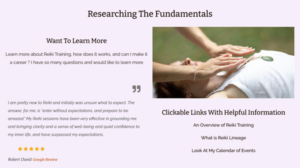
This page is a perfect example of the combination of Search Intent and Building Trust
View PageStep 3 - How Does A Business Website Get Backlinks ?
To get backlinks in 2026, you must focus on quality and relationship-building rather than quantity. Search engines like Google have become highly advanced at identifying and ignoring spammy or artificial links, so beware of those thousands of emails a day you get offering help.
Strategic Outreach & PR
Use platforms like Connectively (formerly HARO) to provide expert quotes to journalists. If they use your quote, they typically provide a high-authority backlink.
Guest Blogging
Write high-quality articles for reputable sites in your niche. Ensure the content is genuinely valuable to their audience and includes a natural link back to your site.
Unlinked Brand Mentions
Search for instances where your brand or product is mentioned online without a link. Reach out to the author and politely ask them to turn the mention into a clickable link.
Resource Page Link Building
Find "Resource" or "Helpful Links" pages in your industry. If your content provides value, suggest it to the site owner for inclusion.
Collaborate with Indirect Competitors:
Partner with businesses that serve the same audience but don't sell the same thing (e.g., a wedding photographer linking to a florist). .
Meet HARO
Now, HARO has a fresh opportunity to turn things around. With a new rollout and renewed interest, there is hope that the platform can return to being a serious tool for connecting reporters and sources. If they can focus on quality again and cut out the noise, HARO could once again be a real asset to business owners, marketers, and agencies looking to build authority.
View PageStep 4 - How Do You Improve Website Structure and Performance ?
Improving a website’s structure and performance in 2026 requires balancing technical speed with a “user-first” architectural design. Search engines now prioritize “page experience” signals—specifically Core Web Vitals—as heavily as content quality
To Optimize Your Website Structure
Organize content so no important page is more than three clicks from the homepage. Use a "hub-and-spoke" model where broad pillar pages link to specific sub-topic clusters.
Simplify Navigation:
Limit top-level menu items to essential categories to avoid "choice overload". Use breadcrumbs near the top of pages to help users and crawlers understand their current location.
Loading Speed (LCP): Aim for a Largest Contentful Paint (LCP) of 2.5 seconds or less.
In 2026, Core Web Vitals (CWV) are critical ranking factors that measure loading speed, interactivity, and visual stability.
Modern Asset Optimization
Next-Gen Media Formats: Serve images in AVIF or WebP formats, which offer 30-50% better compression than JPEG or PNG
Improve Your Domain Authority To Outrank Your Competitors
Building domain authority represents a continuous journey rather than a one-time achievement. While this process requires patience, the payoff is substantial because organic traffic consistently proves to be your most productive source of visitors. These users typically spend more time navigating your site and show a much higher propensity to convert into paying customers. Ultimately, the sustained effort you invest in authority building translates directly into valuable, long-term business growth.